By Suzanna Martinez ·
PEO Health Insurance vs. Open-Market Coverage: How to Compare Your Options
The difference between PEO health insurance and open-market coverage comes down to who holds the plan and how it is priced. With a PEO, your employees join the PEO’s health plan, which is priced from a larger pooled group. With open-market coverage, your company buys its own group plan, priced from your own census and carrier. Neither is automatically cheaper. They are built differently, so compare them on the same terms.
Quick answer:
- A PEO plan can give a smaller employer access to larger-group pricing, often bundled with payroll and HR help.
- An open-market plan usually gives you more carrier choice and a plan that stays with your company.
- Compare total cost, not just premium: fees, deductibles, networks and renewal history all count.
- The right fit depends on your size, your workforce and how much HR help you want.
How PEO health insurance vs open market plans actually work
Picture two ways to buy groceries. You can join a warehouse club and buy at volume prices from a set menu, or you can shop the whole store and pick exactly what you want. The club may cost less on the items it carries. The store gives you the choice.
That is close to the difference here. When you work with a PEO, the PEO becomes a co-employer and typically sponsors the health plan. Your employees enroll in it, and the PEO negotiates and renews the coverage across all its client companies.
With open-market coverage, your company is the plan sponsor. You hold the contract with the carrier, and your renewal is based on your own group’s factors.
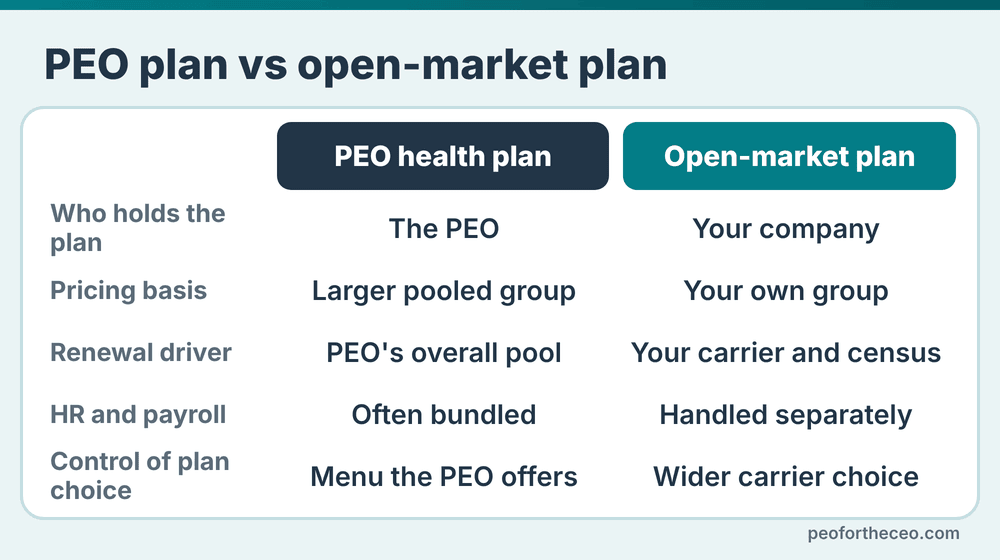 General differences. Individual PEOs and carriers vary, so verify the details of each quote.
Where PEO plans tend to help
A PEO plan can make sense when you are a small or growing employer and the open market has not been kind to you. A few reasons it can help:
- Pricing from a bigger pool. You are pooled with other client companies, which can change the rate you are offered. I explain the mechanics in the PEO advantage and large group policies.
- One bill, one partner. Payroll, benefits administration, workers’ comp and HR support can sit in the same relationship.
- Compliance help. Some employers want someone else tracking filings and rules.
One real example: a 24-employee tech company saved $102,000 by joining a master health plan. It is one client’s result, not a promise. Your outcome depends on your current plan, your location and your census.
Where open-market coverage tends to help
Buying direct has real advantages, and I will say so even though I work with PEOs every day.
- More choice. You can compare carriers, networks and plan designs across the market rather than from one menu.
- A plan you own. If you change payroll or HR providers, your health plan does not have to change with them.
- Clean separation. You can use a payroll company for payroll and a broker for benefits without bundling.
The tradeoff is that you carry more of the administration, and your pricing rests on your own group. If your employees skew older or your area is expensive, the open market may not be kind.
How to compare the two fairly
This is where most comparisons go wrong. A PEO quote may roll several services into one price. An open-market quote usually covers the health plan alone. If you compare one against the other without adjusting, the numbers will not mean much.
Line up these items for each option:
- Plan design. Same deductible, out-of-pocket maximum and prescription tiers, as close as you can get.
- Network. Check your employees’ doctors and hospitals. Network strength varies by state and county.
- All fees. Ask for PEO administrative fees, per-employee charges and any separate charges in writing.
- Services replaced. If a PEO would replace a payroll vendor or HR consultant, count what you would stop paying.
- Renewal history. Ask how the plan renewed in recent years and what drove it.
- Exit terms. Ask what happens to coverage if you leave, and when.
Hidden costs are the usual surprise. A bundled price can look simple and still hide what you are paying for each piece, so ask for itemized pricing. That one request often tells you more than the headline number.
Questions to ask a PEO
- Whose health plan is this, and which carriers and plan options are on the menu?
- How are renewals set: from the whole pool, from our own group, or a mix?
- What fees sit outside the premium, and can they change at renewal?
- What does implementation look like, and who handles open enrollment?
Questions to ask for open-market coverage
- Which carriers did you quote, and why those?
- Is this fully insured or level-funded, and what risk comes with it?
- What do renewals usually look like for groups our size in our area?
- Who supports employees with claims and billing questions after enrollment?
If both sides answer clearly, you have what you need. If either side gets vague, take note.
Which one fits your business
There is no universal winner. Here is how I think about it with employers:
- If you are small, short on HR time and open-market quotes have been climbing, a PEO plan is worth a serious look.
- If you already have strong HR and payroll in place, a specific carrier relationship you value, or an employee base spread across several states, open-market coverage may fit better.
- If you are stuck in the middle, quote both and let the numbers decide.
You can also keep options open. Some employers ask whether they can keep a PEO and buy health insurance separately. It depends on the PEO and the plan rules, so ask before assuming.
Also keep in mind that brokers are paid in different ways. If you want to know how that works before you ask anyone for a quote, I wrote a short explainer on how PEO brokers are paid. Any broker you talk to should be able to tell you plainly how they are compensated.
I would rather you pick the plan that fits than the one I happen to sell. If you want help lining up both options with the same assumptions, I am glad to do that.
Warmly, Suzanna
To compare PEO and open-market quotes side by side, book a no-pressure conversation with me or email me at suzanna@peofortheceo.com.
Frequently asked questions
Is PEO health insurance cheaper than buying group coverage on my own?
Sometimes, but not always. A PEO plan is priced off a larger pooled group, which can help smaller employers, while an open-market plan is priced off your own group. Compare total cost, including PEO fees, on the same plan design. Results vary by state, carrier, census and which PEO you consider.
Who owns the health plan in a PEO arrangement?
In a typical PEO arrangement, the PEO sponsors the health plan and your employees enroll in it through the co-employment relationship. With an open-market plan, your company is the plan sponsor and holds the contract with the carrier directly. That difference affects renewals, control and what happens if you leave.
Can I change carriers more easily outside a PEO?
Usually you have more carrier choice outside a PEO, since you can shop the open market directly. Inside a PEO you generally choose from the plans the PEO offers. If you leave the PEO, expect to replace the health plan too, so plan the timing carefully around an enrollment period.
What should I compare besides premium?
Compare the deductible, out-of-pocket maximum, prescription coverage, network fit for your area, administrative fees, renewal history and the level of support when employees have claims or billing problems. A lower premium can hide a narrower network or fees charged elsewhere, so line up the whole package.
This article is for education only. It is not insurance, tax or legal advice. Plan details vary by carrier, state and plan, so check the specifics for your business and talk with a licensed professional before you decide.